March 22, 2026
We’ve Seen This Before: Reflections on Designing Today
A 20-year reflection on how design tools, roles, and processes have evolved—from Corel Draw to AI-driven prototyping—while emphasizing that fundamentals, collaboration, and problem framing remain constant.

We live in interesting times today as we are all adopting AI tools for Designing Interfaces, Understanding problem statements and beyond.
There are different perspectives to look at the changes:
AI tools are replacing our existing tools - This is partially true, as more of our tools existing tools are having a AI layer to it; Figma started with renaming layers, adding content(was using content reel earlier) and now its Figma Make
Fundamentals are changing - I don’t believe it, in fact we need to revisit our fundamentals of design or any craft to help organisations better use the tools
Our roles are changing - I remember the failed tamil movie song - 'மாற்றம் ஒன்றுதான் மாறாதது',
"Nothing endures but change" - Heraclitus, Greek philosopher.
Our roles have always changed and we have always adopted the new tools faster; the question is can we evolve at a faster pace and continue to do so as every release of ChatGPT/Claude.
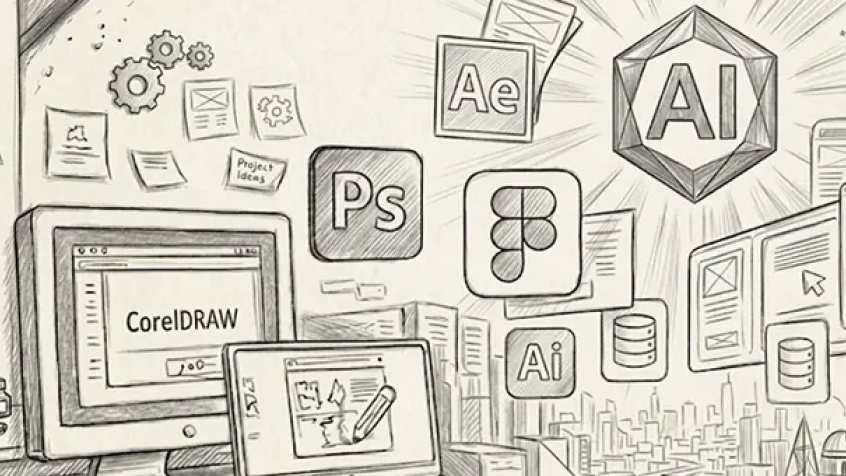
I want to talk about a few themes, starting with Vibe coding, PMs doing design - fading boundaries of roles, but starting with what I have observed as change in the last 2 decades since I started designing Interfaces in Corel Draw. A strange choice for UI design : )
I want to step back and go over my journey as a Designer/Research over the last 2 decades to understand what has evolved.
2007-11
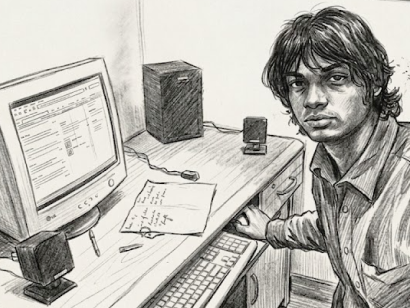
I discovered design, actually I discovered tools and their knowledge made me a designer. The first was Corel Draw, definitely an odd choice for a digital designer. Later I realised. Photoshop is used, for those who remember this time. We have to select/unselect layers to export the screens to developers. And a lot of the time was spent in dev handover. We don’t speak about Dev handover anymore today. Thank you Sketch/Figma
It was all about design interfaces - there were a few who talked about UX then.. And you could claim, as I did, I could do UX Design/Interaction design and get a job - what made you one was awareness of the user, some understanding of how the company makes money, =and communication which later became, Is he/she good with design communication and storytelling?
Interface Design was the need - how many screens can you create in a day? I was asked this during an interview and I answered 5 screens
2011-2018
Emergence of Research led design, field visits to understand customer needs, Maslow’s hierarchy; The focus was building Component libraries and reusing them for consistency > Design System, alignment with engineering teams - tokens was just the evolution of that thinking.
It is interesting to note that this was the time that PMs were expected to create wireframes in tools like Axure RP, Visio, etc., Is Axure RP still alive? For those who have never heard of it, you can populate dropdowns with real data and make very real prototypes. Designers would convert those into UI design with improvements and share with developers. Designers were still using Illustrator, Omnigraffle, Axurel, Visio to design flows and then finally Sketch rescued all of us and other tools to manage versioning! Seems like a crazy time compared to today.
I was very lucky to spend a lot of time in the field during this time, thank you CKS, Raxa and GSMA for the opportunity.
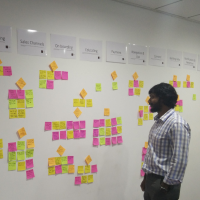
We saw the near death of exploratory research. Maybe the social sector still continues to understand needs and aspirations. If you are one doing research would love to have a chat? I’m still curious about what happened to that world of research - going for a field of 40 days, coming back with a lot of photos, curating, generating themes, presenting ideas and concepts over 3 days. For the friends in CKS, I miss the times we used to spend time in the office late at night to stick the pictures in the wall for the upcoming workshop. I still try to get a lot printed in the office and at home, even today because of that habit. Going to Delhi Print shop and getting the A0’s printed.
2018-before ChatGPT: The Modern Product Design Era
Life with Sketch was good with the majority understanding Design is Problem Solving and curation of ideas. Designers got the seat in the table and part of early product building conversation. The component libraries morphed into Design System - its importance aligned with the coming of age of Product Design - Business thinking helps design better.
As far as research was concerned, Meeting customers and observing them at work becomes research over zoom calls and parsing support tickets. Tools like Dovetail help synthesize insights faster than powerpoints and word did. I don’t see anyone calling themselves Storyteller anymore; Maybe I will write about it a bit later. I still believe Research is important, it has just evolved and taken for granted that Product Designers will do their bit of research.
With tools, one tool emerged which catered to Design, Research and handoff. We switched from Sketch > Figma and everything has changed since then. Tools have always changed. If there is one thing constantly changing, Figma becomes the numero uno. A lot of us migrated to Figma and its pricing has always been confusing.
If there is one take away, our tools have always changed. But fundamentals of what a Designer does hasn’t changed. Personally, over the last 20 years, I have seen trends lasting 3-5 years. Now trends are changing in a shorter time thanks to the faster evolution of tools driven by the AI craze.
To someone who has seen this, it feels like we are going back a bit with everyone doing designs, with confusion around the right tool and roles of the people. But the task of bringing Clarity and visualising the problem, facilitating solving the right problem still needs people(not designers always) who did train themselves to do it.
It is the role of the designer to bring focus back to:
Prototypes = Design Approaches. What we are doing is Prototypes, we used to do it for major projects, Revamps and now we are doing it for everything.
Good products are outcome of Good Collaboration - that is why more than ever we should treat the prototype as our first draft be it in Figma/Figma Make or any other GPT.
Product Owners (not managers) are getting back to creating prototypes in another tool - not Axure to actually clarify the user journey and not take your job.
Finally, Let me start with Vibe coding. For all practical reasons, its prototyping in most cases when not done by an Engineer building a feature by himself. Vibe coding is nothing but building prototypes and showing the vision quickly. All of us have done it for ages now, the big service companies have had dedicated teams with sales who would create this in weeks to get clients or get ideas funded. I hired the first Design Technologist to design prototypes to showcase design vision in 2019. Still later than the early proponents of creative technologies - designer who codes.
For those, non designers who have made it to this far:
What are Designers really doing?
Implementing the Design system on top of Prototypes? No, they are going over the approach playing the role of the user and ensure consistency with other workflows done earlier, especially in B2B SaaS.
Facilitating the conversation around to avoid the teams committing to the first vibe code output and digging deeper until Sunk cost fallacy kicks in and commit ourselves to make it work.
Pushing ourselves to constantly ask if we are solving the right problem? Is there a better way to do it? Are there other Design Approaches? How does Salesforce or Shopify do this?
In the world of consulting, I hear from friends, clients are reaching out with prototypes assuming that everything is done and the ask is to make sure to quickly get to production.
What am I focusing on? This is how I see change today:
As designers, we should focus more on build Systems - UX Systems that can help quickly take a vibe coded prototype across production. There is a great opportunity here. The real promise of Design System and we might have time to do it today.
Go back to fundamentals, there are plenty of foundational courses in design, architecture - knowing to call out good design from bad is a skill.
While storytelling might not see its day again, articulation of design choices and communicating design will be more important.
Be curious and try out every tool that’s possible, and figure out the tools that will help everyone collaborate - Figma used to be the tool - it is certainly going to change.
I will be keen to see if AI tools has indeed saved time in few areas.
From the Vision prototype > real product lot happens. There is still the Design system to adhere to.
Questions to ponder:
Tools : Will we have one tool where we all collaborate? This is something that I try to guess - is it Figma Make? Lovable or something else.
With AI tools prototypes - maybe we should ask it to create sketchy prototypes.
Process : How is collaboration evolving? Will remix be the future? This is definitely possibility.
We shouldn't fall for aesthetic usability effect? Just because something looks doesn't mean it works. Let’s increase the level of skepticism and avoid falling in this trap. This is why there was a time, Designers started with Low fidelity and not use colors and focus on workflows and user journeys rather than on the font type.
Are we missing the basic questioning? Are we solving the right problem? Can the Product Owner still write a short page to give clarity? Go to the white board and give clarity to the stakeholders?
What will happen to organisations that build all the vibe coded PROTOTYPEs?
Do we frame the problem right?
Figma Make: I will compare these tools, a long pending post.
More Articles
See More
Remembering 176 x 208
A reflection on watching sports through the Star Sports app and how a single feature can define the entire viewing experience.
See More

3 steps to master the art of copying app experiences
A reflection on watching sports through the Star Sports app and how a single feature can define the entire viewing experience.
See More

Is User Journey the most powerful service design tool?
User journey mapping is a powerful service design tool that connects team silos, incorporates field research, and ensures iterative product development.
See More
Manufacturing need through design – Visit to IKEA
A visit to IKEA Hyderabad reveals how the store manufactures need through design, using experience elements like the Marius stool and showroom layouts.
See More